
Train MagLev

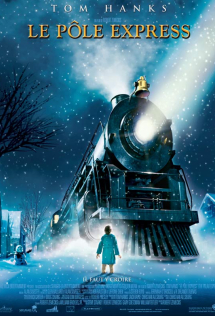

The film “Le Pôle Express” (2004), directed by Robert Zemeckis, tells the story of a young boy's adventure as he embarks on a magical train bound for the North Pole. More than just a means of transport, the train becomes a symbol of faith and imagination. Echoing the evolution of trains from the 19th century to futuristic technologies such as magnetic levitation, it embodies the human quest to push back the limits of what is possible, between dream and reality.
“Le Pôle Express” is an iconic 2004 animated film directed by Robert Zemeckis. It tells the story of a young boy who, one Christmas night, boards a mysterious train bound for the North Pole to meet Father Christmas. Beyond its magic, the train becomes a symbol of adventure, faith and the passage to the imaginary world.
The “Pôle Express” train is visually inspired by the classic steam locomotives of the 19th century, a time when trains represented the industrial revolution and the conquest of distance. It is a vehicle that, as in that era, transforms the impossible into the possible, linking distant worlds and opening the door to new experiences. Yet in the film, the train goes beyond mere technology to become a metaphor for the inner journey, where each passenger is confronted with his or her beliefs, doubts and hopes.

The journey aboard the “Pôle Express” is much more than a simple physical movement; it is a crossing between the real and the imaginary. The train defies the laws of physics as it traverses snow-covered landscapes at a speed impossible for a conventional locomotive. This surreal aspect illustrates the idea that all journeys, whether technological or spiritual, sometimes go beyond the limits of reality.
Looking to the future, we can draw a parallel between the “Pôle Express” train and magnetic levitation (maglev) trains. These futuristic trains, using magnetic fields to move without contact, promise to revolutionise transport with extraordinary speeds, while being silent and environmentally friendly. Like the magic train in the film that floats above the landscape, maglev trains will levitate above the tracks thanks to magnetism.

Just as the “Pole Express” transports its passengers into a world of dreams and magic, the trains of the future, which will move thanks to magnetic energy, will carry passengers on ever faster and smoother journeys, pushing back the limits of engineering. The evolution of trains, from the first steam locomotive in 1804 to the maglev trains projected for 2500, embodies this human quest to go ever further, ever faster, while innovating with more sustainable technologies.
“Le Pôle Express”, with its magical, timeless dimension, symbolizes the evolution of trains, which are no longer just means of transport, but vectors of discovery, imagination and progress. As in the film, where magic takes children beyond the frontiers of the known, the future of trains lies in the human capacity to push back the limits of what is possible, with technologies today as extraordinary as the magic of the “Pôle Express”.
